Turning years of UI design experience into a scalable learning experience
I partnered with the UX Design Institute to create and deliver a professional UI design course for aspiring and practicing designers.
The challenge was to translate years of professional design experience into a structured learning experience that could teach complex concepts clearly, consistently, and at scale.
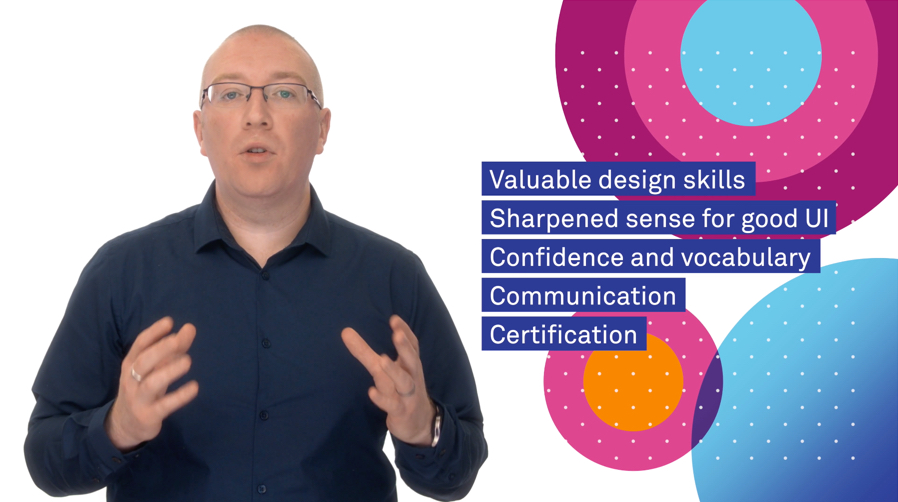
This involved not only designing the curriculum itself, but also writing the instructional content, creating supporting visuals, and presenting the material as the on-screen instructor throughout the course.
The challenge
Experienced designers often operate on instinct. Through years of practice, many design decisions become second nature. The challenge was to unpack those mental models and transform them into lessons that students could understand and apply in their own work.
The course needed to teach practical, industry-relevant UI design skills; work for learners with varying levels of experience; balance theory and application; keep learners engaged throughout a self-paced online format; and scale to a global audience.
My role
I was responsible for the end-to-end course design and delivery: curriculum design, learning structure and sequencing, lesson planning, script writing, visual teaching materials, presentation design, on-camera delivery, video recording, content refinement, and review.
Creating a structured learning journey
Rather than presenting UI design as a collection of isolated topics, I designed the course as a progressive learning experience. Each lesson built on previous concepts, helping learners develop a deeper understanding of how visual design decisions work together to create effective interfaces.
Topics included visual hierarchy, typography, layout systems, colour, components and patterns, design systems, consistency and usability, and interface refinement.
The focus was not simply on creating attractive interfaces, but on understanding the rationale behind design decisions.
Writing for clarity
A major part of the project involved script writing. Every lesson had to be carefully structured to explain concepts clearly while maintaining engagement and momentum.
This required simplifying complex concepts, sequencing information logically, creating memorable explanations and examples, and maintaining consistency across the entire course.
The process was similar to the work I do today when communicating complex systems and strategies to stakeholders: breaking difficult ideas into understandable pieces.
Designing the visual narrative
Alongside the written content, I developed visual examples and teaching materials to support the lessons. These included interface critiques, before-and-after comparisons, visual breakdowns, process illustrations, and annotated examples.
The goal was to make abstract concepts tangible and immediately understandable.
Presenting the course
Once the curriculum and scripts were complete, I recorded the lessons as the on-screen instructor in a professional studio environment.
This required a different skill set again: public speaking, on-camera presentation, explaining concepts naturally and confidently, and maintaining clarity and energy across long recording sessions.
The result was a consistent learning experience where the same person who designed the material also delivered it directly to learners.
Impact
The course became part of the UX Design Institute's professional education offering and has helped teach UI design principles to designers around the world.
More importantly, the project reinforced a skill that continues to be central to my work today: the ability to take complex subjects and make them understandable.
Whether teaching UI design, explaining information architecture, or communicating long-term product strategy, the underlying challenge is often the same: helping people understand complexity so they can make better decisions.
Skills demonstrated
Curriculum DesignLearning Experience DesignVisual CommunicationInformation ArchitectureContent DesignScript WritingPresentation DesignPublic SpeakingVideo ProductionDesign Systems ThinkingStrategic Communication